
Posted by Venomous Tuning on Aug 18th 2026
Do I Need Wideband Air Fuel and a Dyno to Tune My Shelby GT500?
Why We Insist on a Dyno for Remote WOT Tuning (And What a Broken Gauge Reminded Me About Bad Data)
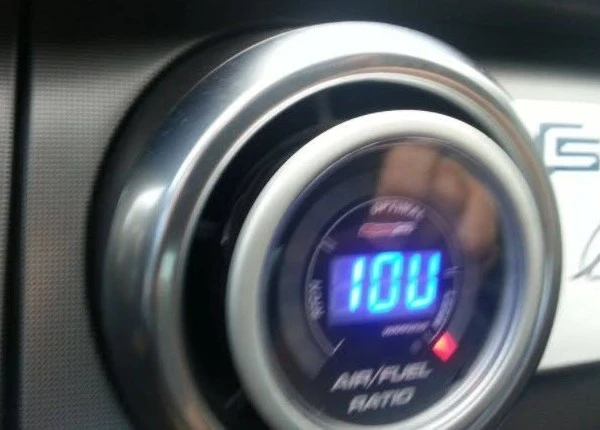
I glanced at my own wideband gauge one day. A couple of dead LED segments turned what should've read as an air/fuel number into "IOU." Kind of funny. Except it's actually the whole point of this post: get your air/fuel data wrong on a supercharged car, and the "IOU" isn't a joke anymore. It's a bill for a rebuilt engine.
The Data Problem Nobody Explains Properly
If you own a 2007-2010 GT500, here's something most people never get told plainly: your factory O2 sensors are narrow band. They're built to confirm you're roughly at 14.7:1 for emissions purposes at idle and cruise. The moment you're in boost at wide-open throttle — the exact moment it matters most — a narrow band sensor is essentially blind. It cannot tell you if you're sitting at a safe 11.5:1 or a dangerously lean 13.5:1.
2011-2014 cars got a real factory upgrade here: a genuine wideband O2 sensor that reports usable AFR across the full range, boost included. That's why some of the "just send me a datalog" remote tuning approaches can work reasonably well on later cars — there's real data in that log.
Apply that same approach to a narrow band 07-10 car and you're not tuning to data anymore. You're tuning to a guess wearing a datalog's clothes.
What We Actually Require Before We'll Touch a WOT Pull
This isn't theoretical for us — it's built into our process for every custom calibration. Before we'll approve a car for boost or over half throttle, here's what has to happen first, and why:
Idle and slow-rev logging comes first, always. We dial in driveability fueling with a cold-start log up to operating temperature, then a slow rev to 4,000 RPM, before anything involving boost is even on the table. Your initial file cannot be used in boost or over half throttle until this step is signed off — that's not a suggestion, it's a hard stop in our process.
Pre-2011 cars need real wideband data, period. If you don't already have an aftermarket wideband monitor installed, we require securing dyno time — we'll help locate a shop near you — so we can remotely tune the wide-open-throttle portion with actual verified AFR in front of us, not an inference. 2011+ cars have that wideband built in from the factory, so the requirement is naturally already met.
One pull at a time. No exceptions. When we do get to the WOT gears logging — third gear on the street, fourth on a dyno, 2,000 to 5,000 RPM — we never authorize more than one full-throttle pull without reviewing the data first. If there's a fueling or equipment issue, we need to catch it before it repeats, not after.
We set hard abort thresholds, and we mean it. If AFR goes leaner than 12:1 or there's any audible knock during a pull, the pull gets aborted immediately. No finishing the run "to see." That threshold exists because lean-under-boost is exactly how you turn a tuning session into an engine rebuild.
We check the physical evidence too. After WOT logging, we have customers pull and inspect spark plugs — specifically looking for detonation specks on the white ceramic insulator. Data on a screen is good; confirming it against what's actually happening inside the cylinder is better.
Only once fueling is confirmed clean and the timing is something your car and your local fuel actually tolerate do we turn adaptive learning back on and call it finished.
Remote Describes Where We're Sitting, NOT How Rigorous We Are.
We've run this process on close to 1,500 of these cars over the past 20 years. The reason we can do that safely from a distance isn't that we've gotten looser with the standards — it's that we built the process around getting real, verified wideband air/fuel data at the one moment it actually matters, boost included, every time, no shortcuts.
If a shop can't tell you exactly how they're verifying air/fuel ratio on your specific car during a WOT pull, what the stated AFR and rev limits should be on YOUR car and what equipment they're using, find another shop. The ones we refer to know all these critical points.
Questions about your car specifically? Call us at 352-800-4407.